
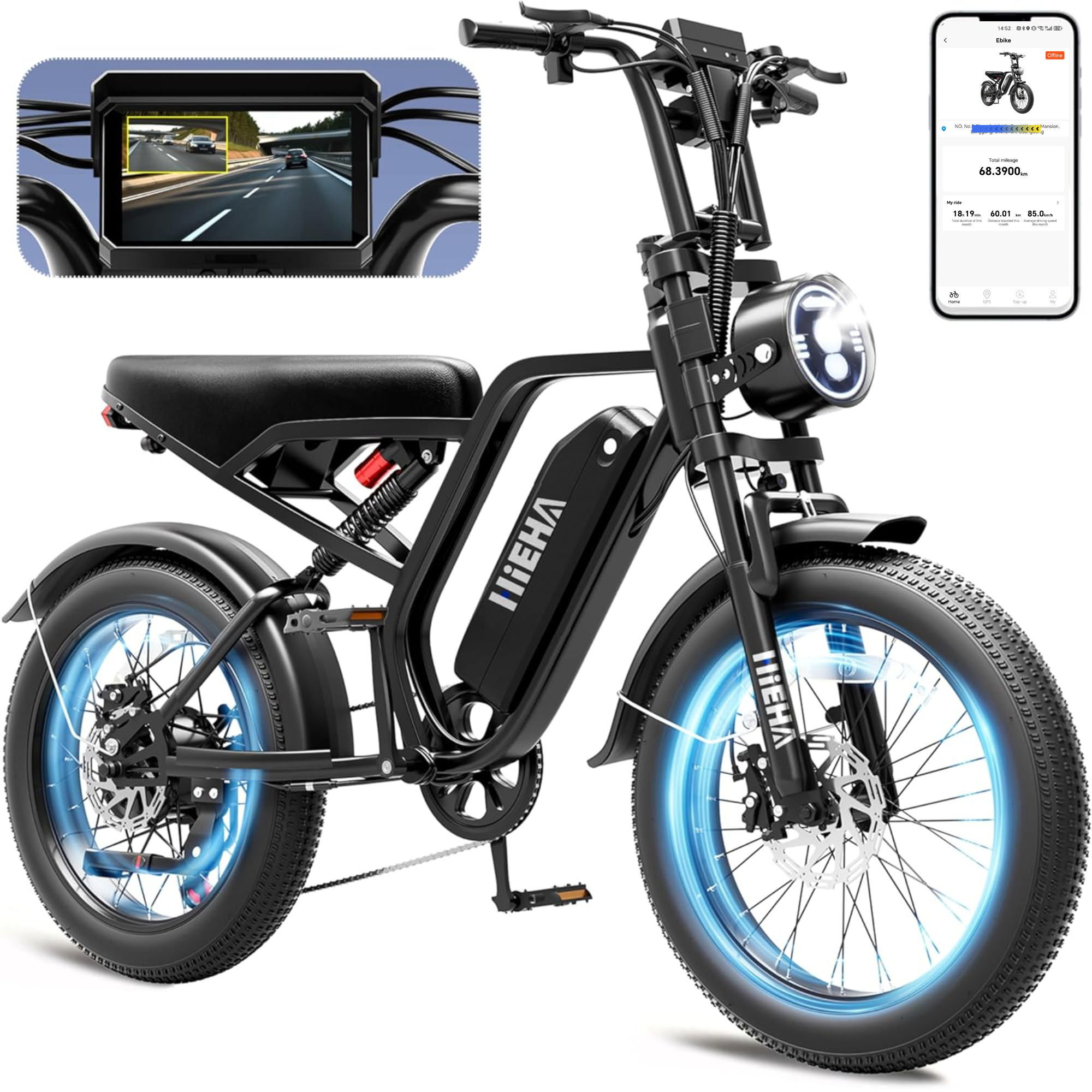
Quick answer: Choose the HIEHA SU8 1.0 when you want a straightforward, value-focused moped-style e-bike with an LCD display. Choose the SU8 2.0 when the touchscreen, CarPlay and Android Auto support, HIEHA app support, and dual 1080P cameras are features you will genuinely use. Both current product pages list a 750W rated/1500W peak motor, a removable 48V 15Ah battery, 20 × 4.0-inch fat tires, full suspension, and a 40–70-mile estimated range; real-world results vary with the rider and conditions.
This comparison is deliberately narrow. It separates the features HIEHA currently lists for both models from the features that change the ownership experience. It does not treat a product-page estimate as a personal result, and it does not rely on changing price, stock, shipping, or certification wording. Start by confirming both models in the HIEHA E-Bike collection, then use the decision questions below to decide which configuration fits your route and routine.
Start with what is shared
The two SU8 versions share the basic shape of the decision. HIEHA lists each as a moped-style fat-tire e-bike with 20 × 4.0-inch tires and full suspension. Each current product page lists a 750W rated, 1500W peak motor; a removable 48V 15Ah battery; a 40–70-mile estimated range; and a maximum load of up to 330 lb. Those shared specifications mean the first question is not which model is universally “better.” It is whether this kind of e-bike suits your regular route, storage space, lifting requirements, local rules, and willingness to charge and maintain a removable battery.
Range deserves particular care. HIEHA presents 40–70 miles as an estimate, not a promise. Rider weight, terrain, speed, assist level, weather, battery condition, tire pressure, and riding habits can all shift the result. If your planned trip sits close to either end of that estimate, plan around your real route rather than assuming the advertised maximum. The same caution applies to any performance specification: treat it as a published product detail to verify, not as a guarantee for a particular hill, commute, or rider.
For a broader way to match an e-bike to daily needs, read what to look for when buying an electric bike. It is a useful companion because it puts storage, support, and recurring ride conditions ahead of a single feature list.
The differences that change the choice
| Decision area | SU8 1.0 | SU8 2.0 | What to ask yourself |
|---|---|---|---|
| Display | LCD display | Smart touchscreen display | Will you use a touchscreen interface often enough to matter? |
| Connected features | Standard ride controls | CarPlay and Android Auto support; HIEHA app support | Do you want supported navigation and connected functions at the display? |
| Cameras | Not listed in the current comparison | Dual 1080P front and rear cameras | Is a built-in camera system part of your routine or just a nice extra? |
| Shared foundation | 750W rated/1500W peak; 48V 15Ah removable battery; 20 × 4.0-inch tires; full suspension | 750W rated/1500W peak; 48V 15Ah removable battery; 20 × 4.0-inch tires; full suspension | Does the shared SU8 format fit your route and storage needs? |
| Extra-battery option | Confirm current options on the product page | Long Range Bundle includes an extra original battery | Do you need battery flexibility, rather than a promised doubled range? |
The cleanest distinction is the interface and smart-feature set. The current SU8 1.0 product page lists an LCD display. The current SU8 2.0 product page lists a smart touchscreen, CarPlay and Android Auto support, supported HIEHA app features, and dual 1080P cameras. Those are meaningful only if they solve a recurring need. A rider who mainly wants simple display information and predictable everyday controls may prefer the 1.0’s simpler setup. A rider who often navigates unfamiliar streets or values connected display features may find the 2.0’s listed extras more relevant.
Choose by your actual riding routine
Choose SU8 1.0 for simple, value-focused use
The SU8 1.0 is the stronger fit when you want the core SU8 format without making connected features the reason to buy. It makes sense for a rider who expects to use an LCD display, wants a moped-style fat-tire e-bike for regular neighborhood or commute riding, and would rather keep the purchase decision centered on the bike’s shared fundamentals. This is not a claim that an LCD is inherently better. It is a reminder to pay only for the interface you are likely to use.
Before choosing it, test the practical details in your own situation. Where will the bike live? Can you move it safely through the doorway or parking area? Will you charge the removable battery indoors according to the manual? Does your route include surfaces where the fat tires and full suspension are appealing, or is the bike’s size and weight a trade-off you should experience first? If a single answer is unclear, ask HIEHA support before ordering rather than filling in a gap with an assumption.
Choose SU8 2.0 for smart-riding features
The SU8 2.0 is the better match when its listed touchscreen, supported CarPlay and Android Auto functions, app support, and dual cameras would have a place in your normal rides. For example, a rider who regularly navigates different routes may value having supported connected features at the display. A rider who wants camera hardware integrated into the bike may also find the 2.0 more compelling. These are convenience and information features, not substitutes for attention, safe riding judgment, or compliance with local e-bike rules.
Confirm compatibility before you make the upgrade decision. “Support” on a product page does not mean every phone, app version, or feature configuration will work the same way. Check the current product page, your phone’s requirements, and any setup guidance. If the camera system is central to your choice, ask what it records, how files are managed, and what features are supported before checkout. It is better to confirm the specific use case than to infer capabilities that are not stated.
How to think about range and the bundle
Both models are currently listed with a removable 48V 15Ah battery and a 40–70-mile estimated range. That common battery specification does not make their range identical in every real trip. Two people can obtain different results on the same bike because speed, assist setting, elevation, payload, temperature, road surface, and battery condition differ. For a useful estimate, look at your longest regular round trip, leave a buffer, and consider where you can charge.
The SU8 2.0 Long Range Bundle is currently described as including an extra original battery. That can add flexibility for longer routes or backup power, but it should not be described as guaranteed doubled range. An extra battery still needs safe storage, the correct charging routine, and confirmation that the package and inventory shown at checkout match the current product page. If you need a replacement or extra battery, check model compatibility first; battery fit is product-specific.
Battery care is part of the decision, not a post-purchase footnote. Use the supplied manual and HIEHA’s current support guidance for charging, locking, storage, and inspection instructions. Stop and contact support if the battery, charger, or connectors appear damaged or something about the setup feels unsafe.
Do not decide on unresolved or volatile details
Some facts move too quickly or are too model-specific to turn into evergreen buying claims. Stock, promotional price, shipping timing, included accessories, and available bundles can change. Check the live buy box and checkout for those items. Likewise, review the current warranty and return terms instead of relying on a summary from a blog post. This comparison does not use product claims that need a separate documentation check, and it avoids treating a page’s availability indicator as a promise.
Brake and safety documentation are also areas where precision matters. Do not choose either model based on an assumption about a certification mark, a brake component, or a regulatory classification. Read the current product information and the manual, and contact HIEHA if that specific detail is material to your decision. Local e-bike classifications and use rules may also affect where and how you can ride; check the rules that apply where you plan to use the bike.
Make a five-minute comparison before checkout
- Write down your regular ride. Note the distance, hills, surface, parking, and whether you can charge conveniently.
- Separate needs from extras. Put the shared SU8 features in one column and the touchscreen, connected features, and cameras in another.
- Check the live pages. Confirm the current configuration, package, price, inventory, and terms directly on the product and collection pages.
- Confirm support details. Review the manual and ask support about any compatibility, setup, safety, or policy question that would change the purchase.
- Choose the model you will use. The right upgrade is the one that improves your recurring ride, not the one with the longest feature list.
If ride comfort is a deciding factor, compare the shared full-suspension format with your usual surfaces rather than assuming it solves every rough-road issue. The related guide Full Suspension vs. Hardtail E-Bikes can help frame that question. Tire pressure, setup, route conditions, and rider expectations still affect comfort and control.
The bottom line
The HIEHA SU8 1.0 and SU8 2.0 share the core moped-style, fat-tire, full-suspension platform. The decision turns on the SU8 2.0’s currently listed smart touchscreen, CarPlay and Android Auto support, HIEHA app support, and dual 1080P cameras. Choose the SU8 1.0 if the shared ride format and a simpler LCD interface fit your needs. Choose the SU8 2.0 if the connected and camera features will make your normal rides more useful. In either case, verify the current product details and policies before purchase, and follow the manual for safe setup, battery care, and first rides.
Share:
How to Plan an E-Bike Commute That Works Every Day
The Practical E-Bike Maintenance Checklist