
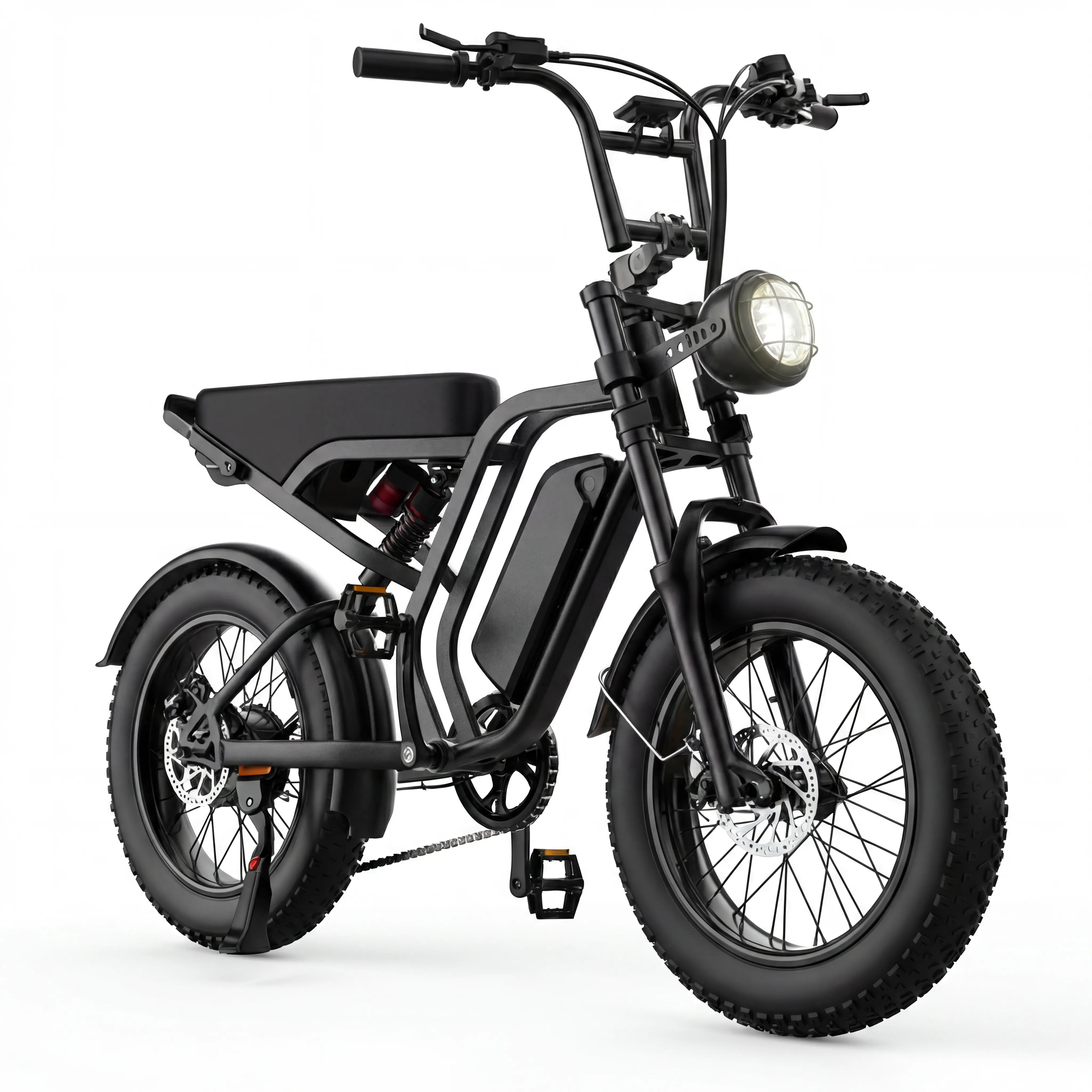
Quick answer: A full-suspension E-Bike can be a practical choice when rough pavement, gravel, repeated bumps, or comfort are routine parts of your ride. A hardtail can be the cleaner fit when most miles are smooth, you value simpler ownership, or storage and transport matter. Choose for the surface you ride most often, then confirm the complete bike’s fit and weight.
Key takeaways
- Full suspension means the bike has front and rear suspension; a hardtail normally has front suspension only or a rigid rear frame.
- Suspension can improve comfort and control on uneven ground, but it adds moving parts and does not replace careful riding.
- A hardtail may feel more direct on smooth pavement and can be simpler to inspect and maintain.
- Frame fit, tire volume, pressure, cargo, total bike weight, and storage are as important as suspension layout.
Full suspension vs. hardtail at a glance
| Decision factor | Full-suspension E-Bike | Hardtail E-Bike |
|---|---|---|
| Broken pavement and repeated bumps | Rear suspension can reduce sharp impacts reaching the rider | Front suspension and tire setup do more of the work |
| Smooth paved commuting | Can be comfortable but may be more than the route needs | Often feels direct and straightforward |
| Gravel and rough paths | Can help maintain comfort when terrain is recurring | Can work well on maintained surfaces with suitable tires and technique |
| Maintenance | More pivots and components to inspect | Fewer rear-suspension parts to manage |
| Storage and transport | Check complete-bike size and weight carefully | May be easier to move, depending on the model |
| Rider experience | Can feel composed over bumps; setup still matters | Clearer road feedback; posture and tire choice still matter |
These are tradeoffs, not rules. A well-fitting hardtail with appropriate tires can be comfortable on many routes, and a full-suspension bike can be useful on pavement if its other characteristics suit the rider.
What suspension changes on an E-Bike
Suspension helps the wheels and rider deal with uneven surfaces. On a full-suspension design, the front fork and rear system can move independently over bumps. On a hardtail, the front end may absorb impacts while the rear frame remains fixed.
The effect depends on suspension design, setup, tire volume and pressure, rider position, speed, load, and the size of the bump. More suspension does not make potholes harmless, guarantee traction, or make every trail appropriate. It also does not override local access rules or the bike maker’s limits.
Choose by the surface you ride most
Mostly smooth pavement
For a regular commute on maintained pavement, a hardtail may be the simpler choice. It can provide a direct feel, while correct tire pressure, fit, and a front fork can handle ordinary road texture. If your route contains only occasional broken blocks, full suspension may not solve a daily problem you actually have.
Rough roads, gravel, and broken shoulders
When a route repeatedly includes washboard, patched pavement, curb transitions, or rough gravel, rear suspension can make longer rides more comfortable. It can also help keep the rider from being bounced around, but it still calls for a controlled pace, attentive braking, and a line suited to the conditions.
Mixed-use routes
Write down how many miles you spend on each surface. A bike chosen for a two-block rough segment may add compromises on the other ninety percent of the ride. Conversely, a rider who hits rough pavement every day may value the comfort more than a small weight or simplicity advantage.
Comfort, control, and energy use
Suspension is one part of comfort. Tire width and pressure, saddle position, grips, reach, and rider posture can make a substantial difference before the route gets rough. A test ride should include the real obstacles you expect: driveway lips, broken shoulder, gravel, and the speed at which you normally travel.
For an E-Bike, energy use is also route-specific. Rough terrain, hills, higher assist, speed, wind, cargo, and repeated starts can change the distance from a charge. Do not assume a suspension layout guarantees a particular range; plan from the conditions you actually ride.
Maintenance, storage, and transport
A full-suspension frame has more moving parts than a hardtail. Keep the bike clean enough to inspect, follow the manufacturer’s service instructions, and address unusual play, noise, or damage promptly. Do not invent a maintenance schedule from a different model.
Before choosing either format, measure the storage area and the task of moving the bike. Consider doorways, turns, elevator space, ground clearance, rack capacity, tire channels, wheelbase, and whether you must carry the bike. Removing a battery may reduce lifting weight on some models, but use the bike and rack manufacturers’ instructions.
A practical decision checklist
A full-suspension E-Bike is worth a closer look when most of these statements are true:
- rough pavement, gravel, or repeated bumps are normal rather than occasional;
- comfort over longer mixed-surface rides is a priority;
- you have space to store and move the complete bike safely;
- you are prepared to follow the additional inspection and service guidance.
A hardtail deserves a closer look when most of these statements are true:
- most rides are on maintained pavement or smooth paths;
- simple ownership and direct handling are priorities;
- you lift, transport, or store the bike in a constrained space;
- you can address ordinary bumps with tires, fit, and a front fork where fitted.
Where the HIEHA SU8 fits
HIEHA lists full suspension and 20 × 4-inch fat tires for both SU8 models. That places the HIEHA SU8 E-Bike collection on the comfort- and mixed-surface side of this comparison. It is a starting point, not proof that the format fits every commute, storage arrangement, or rider.
The SU8 1.0 is described as a moped-style E-Bike with full suspension and a standard LCD setup. The SU8 2.0 is described as a smart moped-style fat-tire E-Bike with full suspension, a touchscreen, app support, and dual 1080p front/rear cameras. Confirm the exact model’s current specifications, fit, weight, and availability on its product page before deciding.
For another route-first comparison, read the fat tire versus regular tire E-Bike guide. Then use the HIEHA E-Bike FAQ for model-specific setup and support questions.
The bottom line
Choose full suspension when repeated roughness is a meaningful part of your routine and you value comfort enough to accept added complexity. Choose a hardtail when most miles are smooth and simple ownership, transport, or storage is more important. The right answer comes from your route and the complete bike, not the suspension label alone.
For a model-specific example of a full-suspension e-bike, see our SU8 1.0 vs. SU8 2.0 comparison, which explains the currently listed shared ride platform and smart-feature differences.
For routes with climbs, pair the suspension decision with a route-first guide to choosing an e-bike for hills that considers gearing, braking, tires, battery planning, and fit.
After narrowing the frame style, use a practical e-bike test-ride checklist to compare fit, low-speed control, braking, and surface comfort on a realistic loop.
\nAfter comparing frame styles, use this route-first commuter versus all-terrain e-bike comparison to weigh pavement, mixed surfaces, stopping patterns, and everyday carry needs.
\n
Share:
How Long Does an E-Bike Battery Last? Care and Replacement Guide
How to Charge an Electric Bike Battery: A Practical Guide